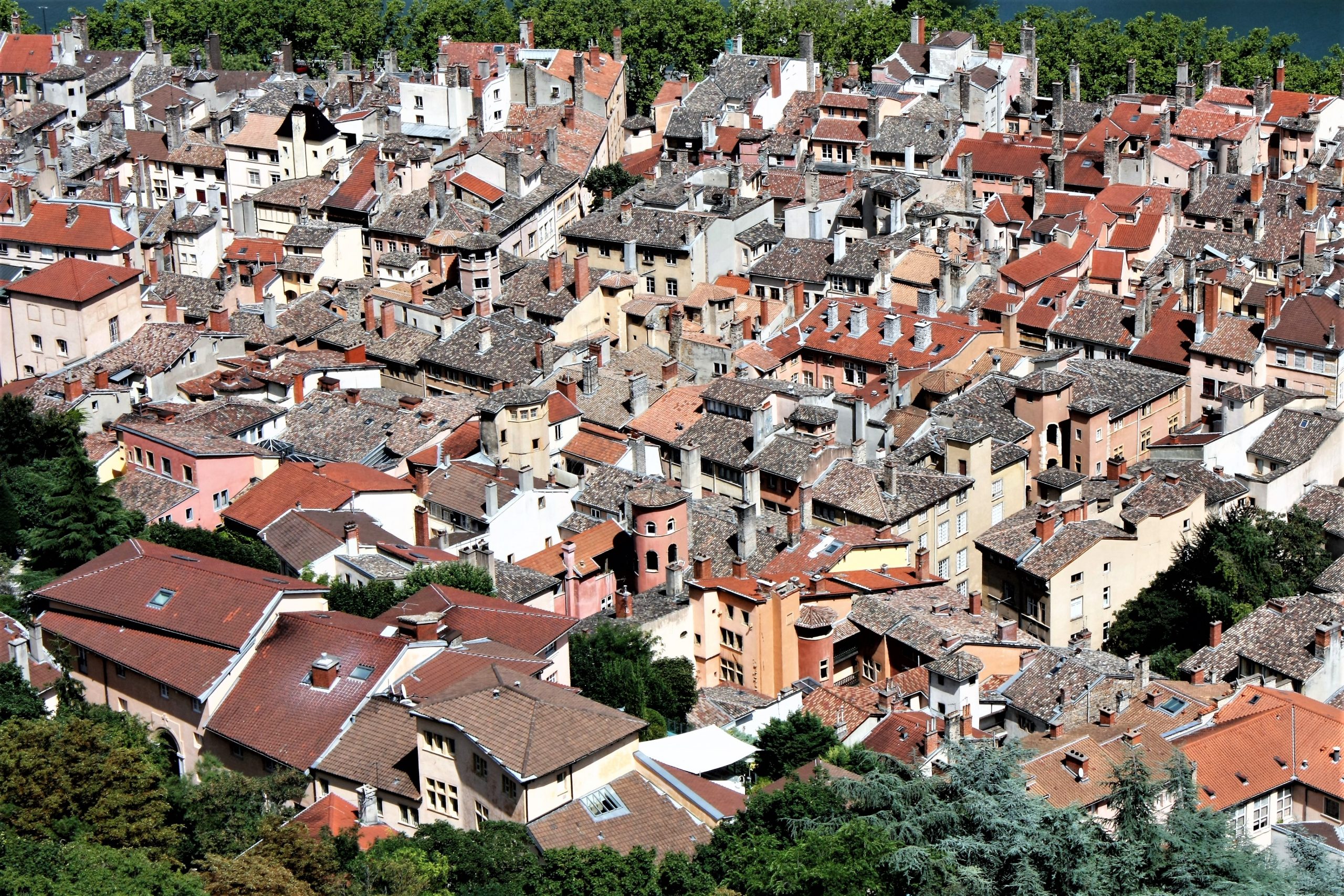
Why is the Vieux-Lyon located at the very foot of the Fourvière hill? And these secret, mysterious galleries named traboules, why are they in Lyon and in Lyon only? And how is it that this district is the 2nd Renaissance complex in Europe after Venice?
Come along with me and you will get the answers to those questions, not to mention many other juicy anecdotes while marveling at the admirable traces in the stone left from the Middle-Ages & the Renaissance. Indeed, far from being an open-air museum, the Vieux-Lyon is a lively, striking and very endearing district! You won’t forget it!
Many treasures are well hidden on the hill Fourvière… Its Gallo-Roman museum, built in the 1970s on the hillside houses the many ancient artifacts gathered over the years as they were discovered. The museum’s framework, a sort of immense flying buttress, protects a vast reinforced concrete cathedral, left with its exposed concrete finish.
A helical ramp, a true spiral of time, draws us into the depths of the past. Here we are, archaeologists setting out to discover, layer by layer, the richness and profusion of objects bequeathed by our ancestors. Among the highlights are the sarcophagus of Bacchus’s triumph, the statue of Neptune, the outstanding mosaic of the circus not to mention the pride of the museum: the Claudian Table.
Let’s not waste a minute—let’s set out to discover how the inhabitants of the capital of the 3 Gauls, named Lugdunum, lived.

In late 18th century, Lyon suffocates within its historic walls. Antoine-Michel Perrache, an engineer and developer has the idea of extending the Peninsula 2 miles to the south, gaining 400 acres from the 2 rivers.
Industry revolutionized the 19th century, which glorified, among other things, the railroad. A railway station is built with great enthusiasm but the difference in elevation between the two rivers meant that the tracks had to be laid on high arches. The result? The station becomes a barrier that hinders Perrache’s project to extend the city center.
From then on, the people of Lyon turned their backs on this neighborhood “beyond the arches.” With a bad reputation, it was relegated to everything the city didn’t want: prisons, slaughterhouses, polluting industries, an industrial port, a marshalling yard and to crown it all prostitution… It wasn’t until Raymond Barre came along in 2000 as the mayor that the project was revived. What a challenge: acres of industrial wasteland to be transformed into a showcase for the city of the 21st century, built with a focus on high environmental quality and civic diversity. This project, one of the largest in Europe, is divided into four major phases. Today, the last phase is almost complete.
This walk “beyond the arches,” in a neighborhood that has become very trendy, the place to be, allows you to understand how Confluence is divided into four areas dedicated respectively to commerce, services, leisure, and culture. It’s a great place to live, between gardens and buildings with stunning architecture. A change of scenery guaranteed!